Showing posts with label Sandy LeBrun-Evans. Show all posts

Saturday, November 23, 2013

HDR - Love It Or Hate It!

"I’m always and forever looking for the image that has spirit! I don’t give a damn how it got made.” — Minor White
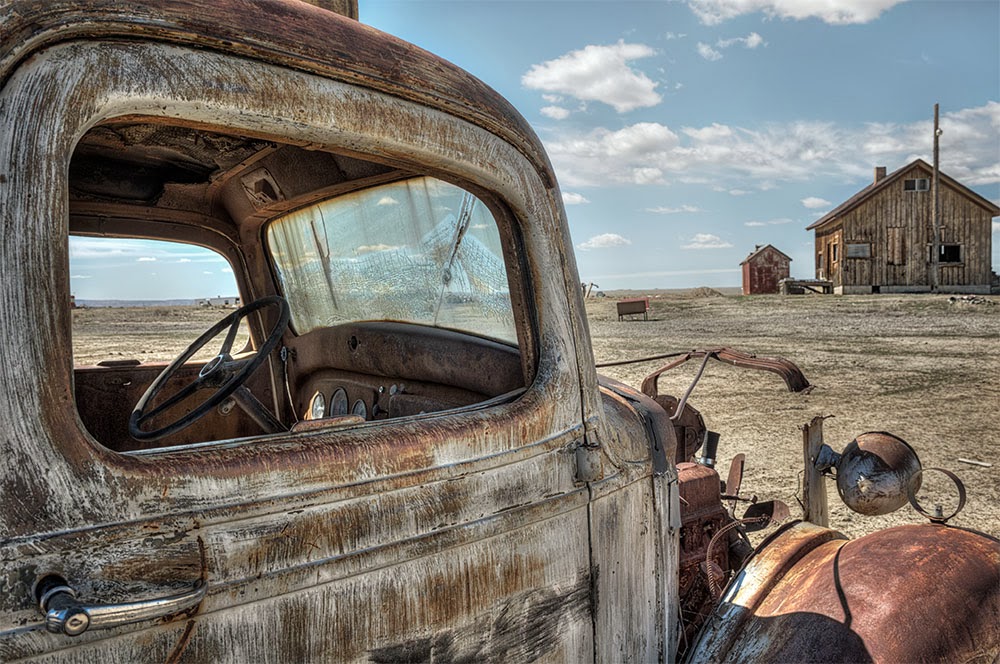
Final HDR Image                      (c) Sandy LeBrun-Evans


Most photographers have an immediate reaction to HDR photography: they either love it or hate it. MEG member Sandy LeBrun-Evans falls in the "love" camp and explains more about her technique.

Why does HDR photography appeal to you? HDR is an acronym for High Dynamic Range, which means that images are composited to extend the dynamic range beyond what our cameras currently can capture. While our eyes can adjust to an image and see the dynamic range, our cameras cannot, so when there is a wide range between light and dark, no single exposure in a camera can capture all of the lights and all of the darks in a scene. By working in HDR, I am able to produce images that include the entire range between light and dark.


Bracketed image examples, light to dark
Your HDR images have a very specific look. How did you develop it? I studied HDR for a couple of years before I made an image that worked for me. I took classes from Dan Burkholder and Tony Sweet and I studied Ben Wilmore’s DVDs on the HDR process. Combining what I learned from all three, I then created a “look” and style that I like for my images.

How do you create an HDR image? To capture all of the lights and darks in a scene, I take anywhere from 3 to 12+ exposures of a single scene. If the scene doesn't have an extreme dynamic range, I set my camera on AV and set bracketing on my Nikon D700 to bracket from 3 to 9 shots (whatever it takes to obtain all of the lights and all of the darks) and shoot. If the dynamic range is extreme, I set my camera to the manual mode and manual focus, bracket by shutter speed, and take as many images as I think I'll need. 
 Composite  .tiff file ready for final processing

I am always on a tripod and I turn off VR (Vibration Reduction) on my lens as VR can cause movement during the capture process.  I then blend as many images as required to cover the full dynamic range in Photomatix software and save the processed image as a .tiff file.  Finally, I take the .tiff file into Photoshop (I'm currently working in PS6) and finish the print as I desire for my final print.

Do you always shoot for HDR or do you only do so for specific images? I usually always bracket when shooting just in case I think I might need to process my image as an HDR image.  You can always spot me — or I should say hear me — because I am the one making that annoying CLICK, CLICK, CLICK... as I capture those 3 to 9 images.

Friday, May 17, 2013

Drive By: Abandoned Towns and A Lesson Learned

Sandy LeBrun-Evans learned a big lesson when developing Drive By: Utah Preserved In Time, her latest show at Multiple Exposures Gallery. Below Sandy talks about shooting in abandoned towns, what makes her feel jittery when out there alone and a lesson she'll carry with her forever.

(c) Sandy LeBrun-Evans
In this series as well as your prior show, Forgotten, you feature abandoned buildings and towns. What catches your eye and makes you stop as you are driving by? What makes a scene worthy of the time you spend photographing it?  While driving by, I'll just see something that makes me pull over or even drive miles to turn around so I can go back and photograph it. If I don't turn around, the image will haunt me.

Before planning a trip, I Google "abandoned places/towns" in the state where I"ll be.  Once I'm there, I'll travel to the areas I found on the Internet, but I also will find gems just driving by.

What makes the scene worthy of my time is what I see through my lens.  I have stopped places and pulled out the camera and tripod, looked through the viewfinder and then decided, "not so much."  Other times when I look through the viewfinder, it's a definite "yes!" and I will work that scene.  What makes it worthy is that it moves my spirit in some way, something that I think is tied to feelings about what used to take place there before it was abandoned.  If I'm looking at a subject and wondering "Who cooked in the kitchen? Who hitched that wagon to the horse? Who put that fence around the house and watched the children run through the yard?" then I'm probably going to be moved enough to photograph it.


(c) Sandy LeBrun-Evans
I actually view abandoned places differently now than I did even just a few years ago. Given our challenging economic times and people very close to me losing their homes in the housing crisis, I wonder a little more about why something was abandoned. Was it by choice? 

Are there people in these towns or are they truly abandoned? How far are these locations from towns or cities that are thriving? Thompson Springs had 39 people in the 2010 census. I would say there are even fewer now.  I met a man named Spydr Mike when he stopped by while I was photographing there. He gave me his card which read "SPYDR MIKE AND FRIENDS, Local Artists."  He makes spiders out of things he finds, but he would love to have the money to reopen the abandoned cafe in town.  Another person I met told me about the ghost that haunts former boardinghouse and its attached bar.  Unfortunately, I did not see the ghost.  I think Cisco is totally abandoned, but there could be some homeless people living in some of the abandoned cars and buildings. 

There are few thriving cities in the areas where I traveled.  What supported most of the abandoned areas I photographed were mines that closed and roads that bypassed their towns.   From what I have read, I-70 bypassing Cisco and Thompson Springs was the downfall of these two towns.


Are you alone when you shoot these buildings and towns? Do you ever feel uneasy? My husband was with me in Utah, but he stays in the car while I wander around the empty buildings and towns.  I thank him for this because it is not easy traveling with a photographer. I have been spooked while out shooting, but usually it's by dogs. 

Cisco was a little scary this visit.  The number of abandoned cars had really risen.  It appeared to be a dumping stations for things and I just felt I was not alone.  I didn't wander much by myself there.
 
You mentioned you returned to Thompson Springs, an abandoned town that you photographed a few years ago. Did you notice any changes or has it stayed the same in its decay?  I noticed lots of changes in both Thompson Springs and Cisco.  It was not in my plans to return to Southeast Utah and visit Thompson Springs and Cisco, but I just did not find what I was looking for in Southwestern Utah.  Beautiful parks, but I was not finding any great abandoned images. 


(c) Sandy LeBrun-Evans
I did find many changes in both towns. In Thompson Springs, my favorite motel was boarded up and I could not walk through and photograph.  The cafe had a lot morejunk in it and the photograph I had taken two years ago could no longer be composed.  In Cisco, many buildings had completely fallen down and I just had an eerie feeling that it was no longer safe to wander around.   

This brought me to a very big lesson learned on this trip -- shoot, shoot, shoot; don't miss an angle or light; stay in a place until you feel you have worn that town out photographing it because it may be your last chance to do so.  You cannot always go back and reshoot!

What is your process when you shoot? Are you working on a tripod? What types of lenses and apertures do you typically use? On this trip I travelled light: tripod, Nikon D700 with two lenses (28-300 and a fisheye), Lumix converted IR camera, and, of course, my iPhone.  When traveling, I usually try and shoot on a tripod as I know I have to get the image right because I cannot go back the next day and reshoot.   I always shoot a minimum of three bracketed images of my subject.  If I am inside a dark building, I will shoot up to 20 bracketed images.  I try and capture the image so I don't lose any detail in the highlights and lowlights.  Typically, my aperture is set anywhere between F11 to F22.

The works in this show were printed on canvas and covered in resin.  Where did you learn to work with resin? Is it easy or hard to do? What is appealing to you about working with resin?   I saw a lot of work encased in resin in galleries out West and really wanted to try the process. Whenever I saw a resin-coated image in a gallery it pulled me in and I thought the process would make the images of abandonment in this show really shine. To learn how to do it, I spoke with a fellow photographer, I Googled and watched videos on YouTube on how to work with resin, and then I experimented.  I did two test images, one on paper and one on canvas and coated them with resin.  I liked the finished resin-coated image in canvas best, so I  decided to present my show on canvas.  It is not an easy process because of the toxicity of the resin. I wore a mask and worked by an open door with a fan pulling fumes out of the house. 

.Please join Sandy and the rest of Multiple Exposures Gallery for an opening reception on Sunday, May 19th from 2pm-4pm at MEG (Studio 312, Torpedo Factory Arts Center, Alexandria, VA).